

Most marketing advice was not written for waste companies. It was written for retailers, restaurants, software companies, and service businesses where the customer has never bought the product before and needs to be convinced to try it. Waste company marketing is a different problem entirely. Your future customers already have a hauler. They are not deciding whether to buy a service. They are deciding whether to switch. That distinction changes everything about how you market, which channels you use, what you say, and what it costs to win a new account. This guide covers every digital marketing channel available to trash and waste companies, how each one works in the context of the waste industry specifically, and how to build a marketing program that produces new accounts at a cost that makes sense for your routes.
Section 01: Understanding the Customer
Understanding Your Waste Customer Before You Spend a Dollar
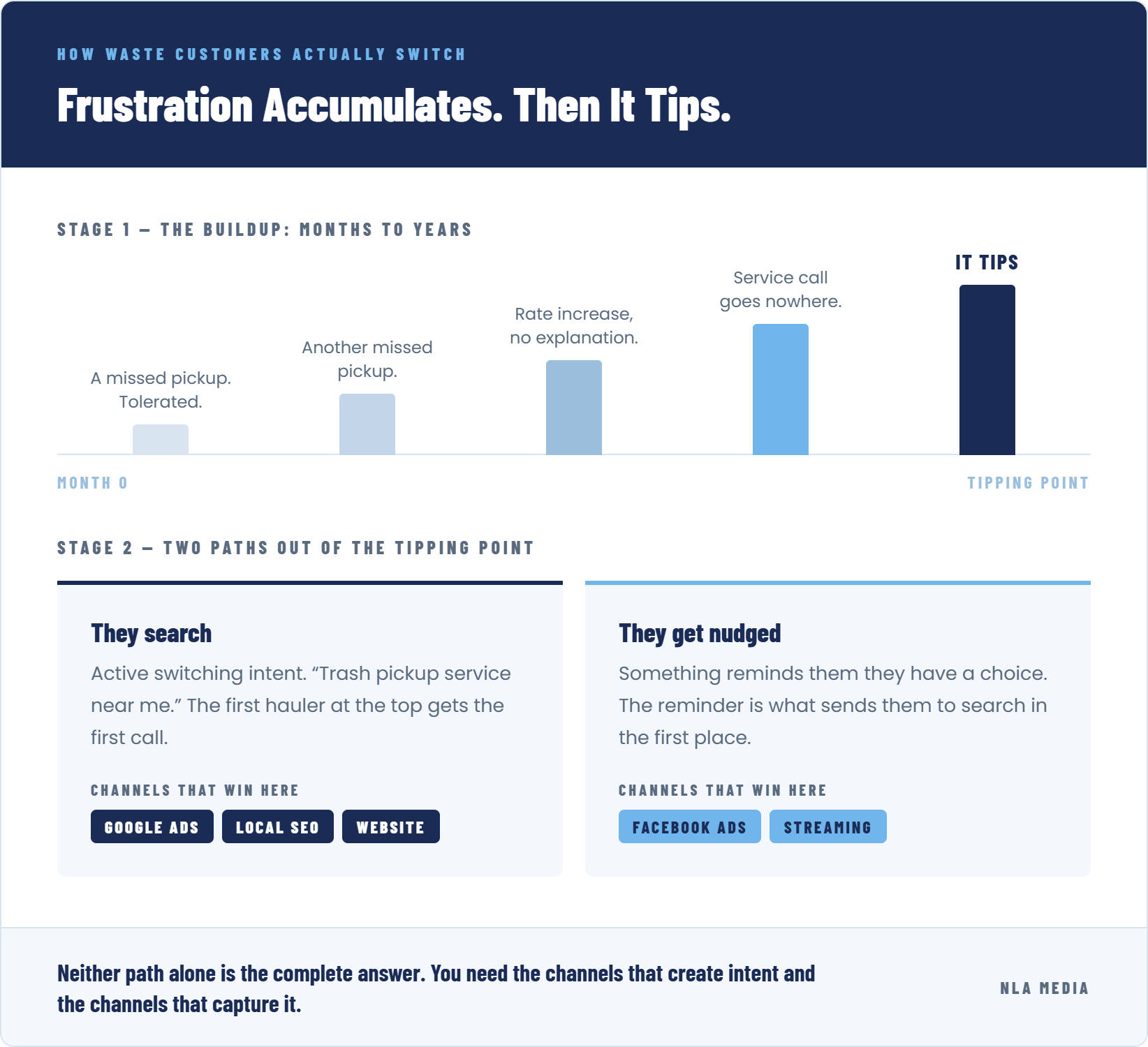
Before you put money into any marketing channel, it is worth understanding how waste customers actually make switching decisions. Most do not switch the moment they first get frustrated. They tolerate a missed pickup. Then another. Then a rate increase arrives with no explanation. Then a customer service call goes nowhere. Frustration accumulates over months or years until it finally tips into action.
When it tips, two things happen. The customer either searches Google for a new hauler (active switching intent) or they see something that reminds them they have a choice, and that reminder becomes the nudge that sends them to search. The first scenario is where Google Ads and local SEO earn their money. The second is where Facebook advertising, streaming ads, and brand awareness channels do their work.
Your future customers already have a hauler. They are not deciding whether to buy a service. They are deciding whether to switch.
Understanding this two-stage process is the most important thing you can know before building a waste company marketing program. Channels that capture active search intent and channels that build the awareness that produces that intent are both necessary, and they work together. Neither one alone is the complete answer.
The commercial side of waste company marketing is a different conversation. Property managers, facilities directors, and business owners making commercial hauler decisions are not going through the same emotional frustration cycle as a homeowner. They are evaluating contract terms, pricing structures, service reliability records, and what happens when there is a service failure. Commercial waste marketing needs to address those criteria directly and tends to work through a longer decision cycle than residential switching.
Section 02: Website Foundation
Your Website: The Foundation Everything Else Sends Traffic To
Every marketing dollar you spend on Google Ads, local SEO, Facebook advertising, and streaming sends traffic to one place: your website. If that website is not built to convert waste customers into new accounts, every other channel underperforms. This is the most common and most costly mistake waste companies make in their marketing programs. They invest in traffic channels before fixing the destination.
Most waste company websites share the same conversion problems. They lead with the company story instead of the customer problem. They bury the service request form below multiple screens of content. They list services without addressing the specific objections that keep visitors from picking up the phone. They load slowly on mobile, which is where the majority of waste customers are browsing when they finally decide to look for a new hauler. And they look nearly identical to every other waste company site in the market, giving visitors no reason to choose one over another.
A waste company website built for conversion does something different. It leads with what the customer wants to know: that you will show up on schedule, that the price you quote is the price they pay, and that someone will answer the phone if something goes wrong. It puts the service request form where visitors are looking when they decide to act. It loads in under three seconds on a phone. It speaks to the specific frustrations that drove the visitor there in the first place.
The city and service area pages on your website matter as much as the homepage. Visitors arriving from local search results or city-specific Google Ads land on those pages, not your homepage. A city page that is a copy-paste of the homepage with a city name swapped in does not convert those visitors and does not rank in local search. City pages built with genuine local market content convert and rank. The difference in account volume over twelve months is significant.
Website design for waste companies is not a luxury upgrade. It is the infrastructure that determines what every other marketing dollar actually produces.
Section 03: Local SEO
Local SEO for Waste Companies: How to Show Up When Customers Are Ready to Search
When a residential waste customer finally reaches the tipping point and decides to look for a new hauler, the first thing they do is search. They type something like trash pickup service in their city, or waste hauler near me, or sometimes the name of a competitor followed by alternatives. Local SEO determines whether your waste company shows up in those results.
Local SEO for waste companies has three main components. The first is your Google Business Profile, which controls how your company appears in the local map pack at the top of most local service searches. A complete, optimized Google Business Profile with consistent name, address, and phone information, a steady stream of legitimate customer reviews, and regular activity signals is the foundation of local visibility for any waste company.
The second component is your website’s technical foundation. Page speed, mobile usability, proper schema markup for local businesses, and clean site structure all contribute to how Google evaluates your site’s authority and relevance for local searches. These are not exciting topics but they are the infrastructure that everything else depends on.
The third component is content. Local SEO for waste companies requires city-specific pages built for the actual search terms waste customers use in each market, written with genuine local content rather than templated copy with city names swapped in. A waste company serving twenty cities needs twenty city pages that are meaningfully different from each other. That is the work most competitors are not doing well, which is where the opportunity is.
Local SEO for waste companies is a long-term investment. It takes months to build meaningful organic rankings, but the accounts it produces have no cost per click attached to them, and the rankings compound over time as your content authority builds.
Section 04: Google Ads
Google Ads for Waste Companies: Capturing Customers the Moment They Are Ready to Switch
Google Ads put your waste company at the top of search results for customers who are already looking for a new hauler. That is a fundamentally different audience than the one you reach with brand awareness advertising. Someone searching for waste removal service in your city has already made the decision to look. They are not being convinced to consider switching. They are evaluating their options right now and the waste company at the top of results gets the first call.
The keyword strategy for waste company Google Ads is different from what works for most service businesses. The highest-value search terms are the ones that signal active switching intent rather than general interest. Terms that include city-specific hauler searches, service quality frustration phrases, and competitor name variations tend to produce more qualified leads than broad service category terms. Volume matters less than intent.
Geographic targeting in waste company Google Ads needs to reflect your actual route economics. A new customer on a dense existing route adds near-pure margin. A new customer at the edge of your service territory costs significantly more to service. Your Google Ads budget should be weighted toward the geographic areas where new accounts have the most value, not spread evenly across your entire service area.
Commercial waste account campaigns require a separate structure. The search terms, ad copy, landing pages, and bid strategy for reaching property managers and facilities directors are completely different from residential switching campaigns. Running both audiences through the same campaign produces mediocre results for both. Separate commercial campaigns targeting the specific search behavior of business waste decision-makers produce leads at a cost that makes the channel worth running alongside the residential program.
Google Ads management for waste companies is the fastest channel for producing new account inquiries. It starts working the day it launches, which is why most waste company marketing programs start here while local SEO builds in the background.
Section 05: Facebook Ads
Facebook Ads for Waste Companies: Building Awareness and Warming the Switching Decision
Facebook advertising for waste companies works differently than Google Ads. Someone clicking a Google Ad is already searching for a new hauler. Someone seeing a Facebook ad is not. They are scrolling through their feed, and your ad appears in front of them based on where they live, behavioral signals, and audience targeting criteria. The goal is not to capture active search intent. The goal is to build brand familiarity that influences the switching decision when it eventually happens and to stay visible to households in your service area throughout the frustration buildup that precedes a switch.
Household-level geographic targeting is what makes Facebook advertising valuable for waste companies. Unlike broadcast advertising that reaches an entire market, Facebook campaigns can be targeted to specific neighborhoods, zip codes, and route corridors. That means your Facebook ad budget goes toward households you can actually service rather than the entire metro.
The creative that works for waste company Facebook advertising is different from generic brand advertising. Residential waste customers have specific, predictable frustrations, and ad copy that acknowledges those frustrations directly, including the missed pickup that never got resolved, the rate increase with no explanation, and the customer service experience that required three calls, and that copy connects with people who are experiencing exactly those things with their current hauler. Generic branding and stock photos of trucks do not.
Facebook advertising for commercial waste account growth requires a separate approach. Commercial decision-makers use Facebook differently than residential customers, and the messaging that moves a property manager is completely different from what resonates with a homeowner. Separate commercial targeting campaigns using business interest and behavioral targeting reach the right business audiences in your service area with creative focused on the reliability and accountability advantages a local hauler has over a national company.
Facebook advertising for waste companies works best as part of a broader digital program. It builds awareness and warms the audience that Google Ads and local SEO then capture at the moment of active search.
Section 06: Streaming Advertising
Streaming Advertising for Waste Companies: Getting on the Screens Your Customers Actually Watch
Your residential waste customers have largely moved away from traditional cable television. They are watching Hulu, Peacock, Roku, and connected TV platforms instead, and they are doing it in the same households you want to service. Streaming advertising for waste companies takes advantage of that shift by placing unskippable video ads on the platforms those households are actually spending their screen time on.
What makes streaming advertising different from broadcast TV, and why it works for local waste companies when broadcast never really did, is geographic targeting. A traditional local TV buy reaches an entire broadcast market, most of which is outside any given waste company’s service area. Streaming platforms offer household-level geographic targeting at the zip code and neighborhood level. A streaming campaign can concentrate impressions in the specific route corridors where new accounts have the most value, rather than paying for reach across an entire market.
Most streaming ad placements are unskippable, which means your message gets delivered in full to every household your campaign reaches. A well-written fifteen or thirty second spot that speaks directly to waste customer frustrations, acknowledges the missed pickup and the unexplained rate increase, and positions your company as the local alternative that actually delivers on its promises gets seen by every household it is targeted to.
Streaming advertising works primarily as a brand awareness and consideration channel for waste companies. It builds familiarity and keeps your company top of mind in your service area so that when frustration finally drives a household to search, your name is already known. That familiarity advantage translates into higher click-through rates on search ads, higher conversion rates on your website, and a shorter decision cycle from first contact to signed account.
Streaming advertising for waste companies fits at the top of the marketing funnel, warming the audience before they search, making every downstream channel more effective.
Section 07: Budget Strategy
How to Think About Marketing Budget as a Waste Company Owner
The right way to think about marketing spend for a waste company is through the lens of route economics, not marketing industry benchmarks. What matters is not what percentage of revenue you spend on marketing. What matters is what a new account is worth on your specific routes and what you can afford to pay to acquire one.
A new customer on a dense existing route is worth significantly more than a new customer at the edge of your service territory. The revenue may be similar but the cost to service is not. A pickup stop on a route where you already have fifteen customers on the same street adds almost nothing to your operational cost. A pickup stop that requires a fifteen-minute detour from your nearest existing route costs real money every week for as long as that customer stays. Your marketing program should reflect that difference through geographic targeting that concentrates spend where new accounts are worth the most.
Customer lifetime value is the other number that determines your marketing budget math. A residential waste customer who stays for eight years at a modest monthly rate represents substantial total revenue. The cost to acquire that customer through digital marketing, even at a few hundred dollars per lead in competitive markets, looks very different when measured against lifetime value rather than the first month’s service fee. Waste company owners who think about marketing cost per new account relative to what that account earns over a realistic retention period make very different budget decisions than those focused on cost per lead as the primary metric.
A new customer on a dense existing route adds near-pure margin. Your marketing program should reflect that difference.
The sequence of channel investment matters for waste companies at different stages of growth. A newer operation building its initial customer base needs to start with the channels that produce results fastest: a conversion-focused website and Google Ads. As the account base grows and the operation has more margin to work with, local SEO, Facebook advertising, and streaming advertising add layers that build brand awareness, reduce cost per acquisition over time, and create a more defensible market position.
Section 08: The Full Stack
The Full Stack: How the Channels Work Together
The most effective waste company marketing programs do not treat each channel as a separate initiative. They treat the channels as a coordinated system where each one plays a specific role and they reinforce each other rather than operating independently.
| Streaming Ads | Builds brand familiarity with households in your service area during evening viewing hours | Top of Funnel |
| ↓ | ||
| Facebook Ads | Reinforces brand presence in the social feed; speaks directly to switching triggers | Awareness |
| ↓ | ||
| Google Ads + SEO | Captures active search intent; puts your company at the top when customers are ready | Conversion |
Streaming advertising works at the top of the funnel, putting your brand in front of households in your service area during the relaxed evening hours. Facebook advertising reinforces that brand presence in the social feed, reaching the same households in a different context with creative that speaks more directly to switching triggers. Google Ads capture the search intent that streaming and Facebook help create. Local SEO works alongside Google Ads in search results, capturing organic clicks that do not cost per click. Your website closes everything.
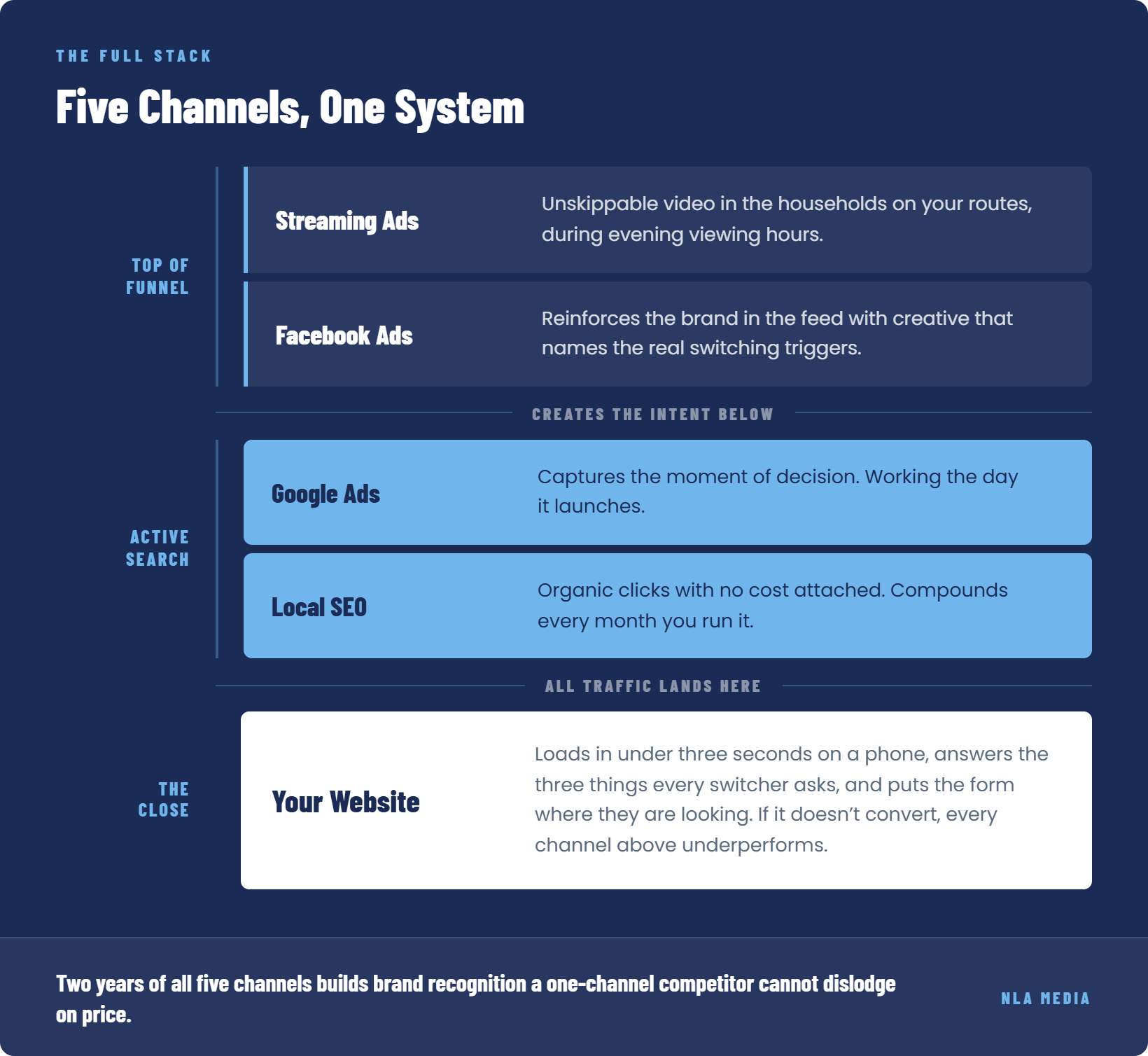
The channels compound over time. A waste company running all five channels for two years has built brand recognition in its service area that a company running only Google Ads has not. That brand recognition reduces cost per acquisition, increases close rates on inquiries, improves customer retention, and makes it harder for competitors to dislodge you with a lower price.
Section 09: Where to Start
Where to Start if You Are Starting from Zero
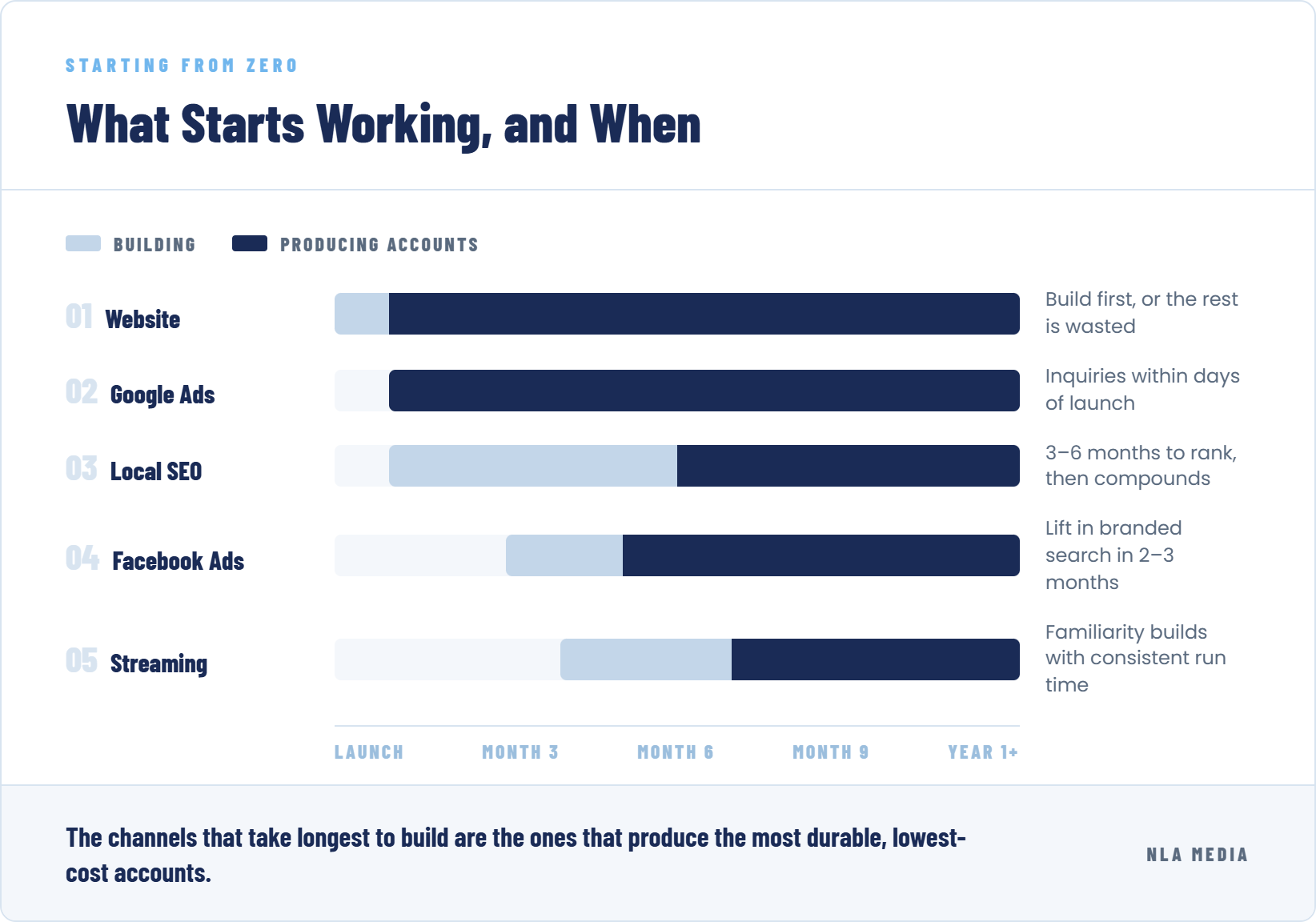
If you are building a waste company digital marketing program from scratch, the sequence matters more than the budget. Starting with the right channels in the right order produces faster results and avoids wasting money on traffic channels before the destination is ready to convert.
Start with your website
Before you spend a dollar driving traffic, make sure your website loads fast on mobile, surfaces your service request form where visitors can find it, and addresses what waste customers need to know before they contact you. A website built for waste company conversion is the foundation that every other channel depends on.
Add Google Ads
Once your website is ready to convert, Google Ads put you in front of customers actively searching right now. This is the fastest path to new account inquiries and gives you the revenue to fund longer-term channels.
Build local SEO in parallel
SEO takes time to produce results, so starting it alongside Google Ads means that by the time your organic rankings build up, your paid program has already established a baseline of new account volume. Local SEO for waste companies reduces your long-term dependence on paid traffic.
Add Facebook advertising
Facebook works best when there is already some brand recognition in the market to reinforce. Once your search and SEO foundation is in place, Facebook advertising warms the same audience your Google Ads are already reaching and builds the awareness layer that compounds over time.
Add streaming advertising
Streaming advertising is a brand-building channel that takes time to compound. The waste companies getting the most out of it have been running it consistently long enough that meaningful household-level brand familiarity has built up in their service area. Start it early and run it consistently.
The full stack takes time to build and budget to run. But each channel you add makes the others more effective, and the compounding effect of a fully-built waste company marketing program is a competitive advantage that is very difficult for a competitor running one or two channels to match.
Key Takeaways
- Waste company marketing is a switching problem, not a first-purchase problem. Your future customers already have a hauler and need a reason and a nudge to change, which shapes everything about how you market.
- Your website is the foundation. Every channel you run sends traffic to your site. A website that does not convert wastes every dollar spent driving traffic to it.
- Google Ads is the fastest channel for new account inquiries because it captures customers at the moment of active search intent. It should be running while local SEO builds in the background.
- Local SEO compounds over time and produces accounts with no cost per click attached. City pages with genuine local content outrank templated pages and convert the traffic they attract.
- Facebook advertising builds awareness and warms the audience that search channels then capture. Creative that speaks to real waste customer frustrations outperforms generic brand advertising consistently.
- Streaming advertising reaches your customers on connected TV with unskippable video targeted to your actual route corridors. It is a brand-building channel that makes every downstream channel more effective.
- Route economics should drive your marketing budget decisions, not industry benchmarks. New accounts on dense existing routes are worth more than accounts at the edge of your territory, and your geographic targeting should reflect that.
- The channels compound when they work together. A waste company running all five channels builds a brand recognition advantage that a competitor running one or two channels cannot easily match.
- The right sequence for building a program from zero: website first, Google Ads second, local SEO in parallel, then Facebook and streaming as the account base grows.
Frequently Asked Questions
What is the most important marketing channel for a waste company?
Your website is the most important single investment because it determines what every other channel actually produces. A waste company with a strong Google Ads program, solid local SEO, and active Facebook advertising still loses a large percentage of the accounts those channels generate if the website does not convert visitors. After the website, Google Ads is typically the highest-priority channel because it captures customers who are actively searching for a new hauler right now and produces new account inquiries faster than any other channel.
How is marketing for waste companies different from marketing for other service businesses?
Most service business marketing is aimed at customers who have never bought the product before. Waste company marketing is aimed at customers who already have a hauler and need a reason to switch. That distinction changes the messaging, the channels, and the creative approach. Waste company ads and website content need to address the specific frustrations that drive switching decisions, not just explain what the service is. The buying decision is also more friction-heavy than most service purchases because switching requires canceling an existing relationship, which means the content needs to work harder to build enough confidence to overcome that friction.
How long does it take for digital marketing to produce results for a waste company?
Google Ads can produce new account inquiries within days of launching. Local SEO typically takes three to six months to produce meaningful organic rankings, and the full compounding effect builds over a year or more. Facebook and streaming advertising build brand awareness gradually, with measurable lift in branded search volume and direct traffic typically visible within the first two to three months of consistent spending. The channels that take longer to build also tend to be the ones that produce the most durable and cost-efficient results over time.
What should a waste company website include to convert visitors into customers?
A waste company website built for conversion needs to address three things immediately: that you will show up on schedule, that your pricing is transparent, and that someone will answer the phone when something goes wrong. Beyond those fundamentals, it needs a service request form that is easy to find on mobile, fast load times that do not lose impatient visitors, and city-specific pages that speak to the local market rather than generic service area content. Reviews and trust signals throughout the site reduce the friction that keeps switching customers from committing.
How much should a waste company spend on digital marketing?
The right number is determined by route economics, not industry benchmarks. The key inputs are what a new account is worth on your densest routes, what your realistic customer lifetime value is, and what cost per new account acquisition makes financial sense given those numbers. A waste company with strong route density and high customer retention can afford to spend more per new account than one with thinner margins and higher churn. Most waste companies benefit from starting with a focused Google Ads and website investment and scaling other channels as the account base and cash flow grow.
Do streaming ads work for local waste companies?
Yes, specifically because of how streaming advertising handles geographic targeting. Traditional broadcast TV advertising was never practical for most local waste companies because the audience was too broad and the cost per relevant household too high. Streaming platforms offer household-level targeting at the zip code and neighborhood level, which means a local hauler can concentrate impressions in the specific route corridors where new accounts have the most value. Combined with the unskippable format that ensures full message delivery, streaming advertising is a viable brand-building channel for waste companies that would never have had access to video advertising through traditional TV.
Should waste companies run Facebook ads and Google Ads at the same time?
Yes, and they serve different purposes in the same marketing program. Google Ads capture customers who are actively searching for a new hauler right now. Facebook advertising reaches households in the weeks and months before they reach that active search stage, building the brand familiarity that influences which company they search for and click on when the moment comes. Running both channels simultaneously means you are present throughout the customer journey rather than only at the moment of peak intent, which produces more total new accounts than either channel produces alone.
Your Competitors Are Marketing. Are You?
Every day you are not running a digital marketing program, someone else is signing up the accounts that could be on your routes. NLA Media builds waste company marketing programs that produce new accounts at a cost that makes sense for your operation. Call us at (719) 635-9988 or click below to book your strategy call.
Book My Strategy Call