

Somewhere in the last two years, "let me Google it" quietly started sharing the stage with "let me ask ChatGPT." For a leaky water heater at 9pm or a dead AC in July, that shift matters more than it does for almost any other kind of search. Homeowners aren't browsing. They're in a mild panic, they want one good answer, and increasingly, an AI platform is the one handing it to them. If your home services company isn't part of that answer, you're not losing a click. You're losing the entire interaction, because there may not be a list of ten blue links to scroll past anymore. There's just the one company the AI decided to mention. This guide breaks down what's actually changing, why home services businesses are more exposed to it than most industries, and what to do about it without blowing up the SEO work you've already built.
Section 01: The Shift
Homeowners Are Asking AI Before They Ask Google
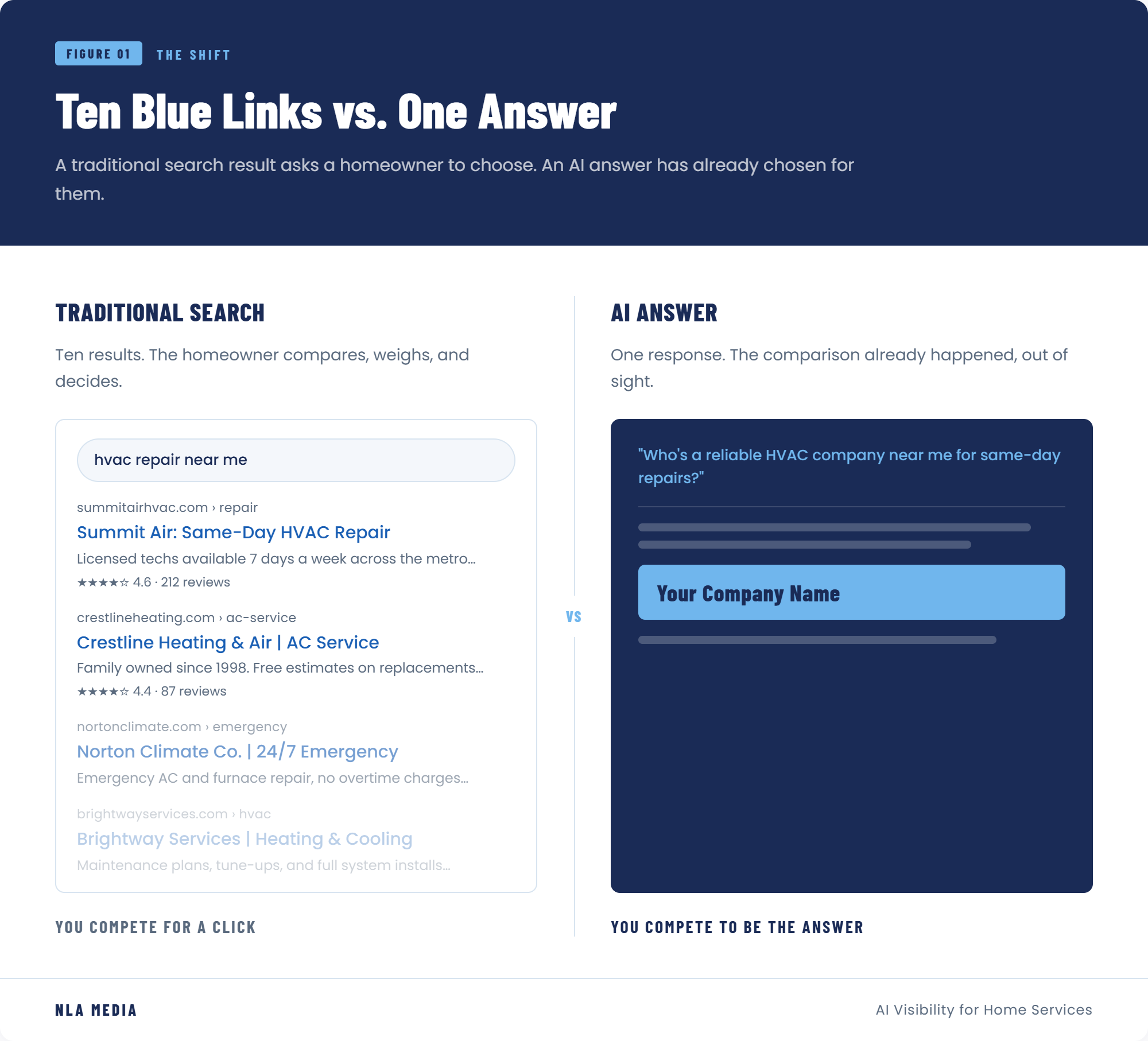
Type "best plumber near me" into ChatGPT, Perplexity, or Google's AI Overview and you won't get ten links to weigh against each other. You'll get an answer. Usually a short one, often with two or three names attached, occasionally with none at all if the platform isn't confident. That is a fundamentally different experience than a traditional search results page, and it changes what winning even means.
On a classic Google search, a homeowner sees your listing next to five competitors and picks based on reviews, price signals, and how the page reads. With an AI-generated answer, the platform has already done that comparison for them behind the scenes and is only naming the companies it trusts enough to vouch for. You're not competing for a click anymore. You're competing to be the answer.
A traditional search result asks a homeowner to choose. An AI answer has already chosen for them.
This isn't a fringe behavior limited to tech-forward early adopters, either. AI Overviews now show up directly inside standard Google searches for a large share of local service queries, meaning homeowners who never opened ChatGPT in their life are still getting an AI-summarized answer before they see a single organic listing. The shift is happening whether a company opts into it or not.
Section 02: The Stakes
Why Home Services Companies Have More on the Line
Not every industry feels this shift the same way. Someone comparing running shoes can afford to read five reviews and make their own call. Someone with water coming through the ceiling cannot. Home services searches are urgent, local, and trust-heavy all at once, which is exactly the combination that pushes people toward a single AI-generated recommendation instead of doing their own research.
Urgency shortens the decision. A homeowner with no hot water isn't building a shortlist, they're grabbing the first name that sounds credible. Locality narrows the field to a handful of real candidates, which is a small enough set for an AI platform to confidently name one or two. And trust drives the whole decision, since a stranger is coming into someone's home. Put those three together and you get a search category where AI platforms are unusually willing to just hand over a name, rather than a list.
That's the risk. It's also the opportunity. A category where AI is comfortable making a direct recommendation is a category where being that recommendation is worth disproportionately more than ranking third on a traditional results page.
Section 03: The Mechanics
How AI Platforms Actually Decide Who to Recommend
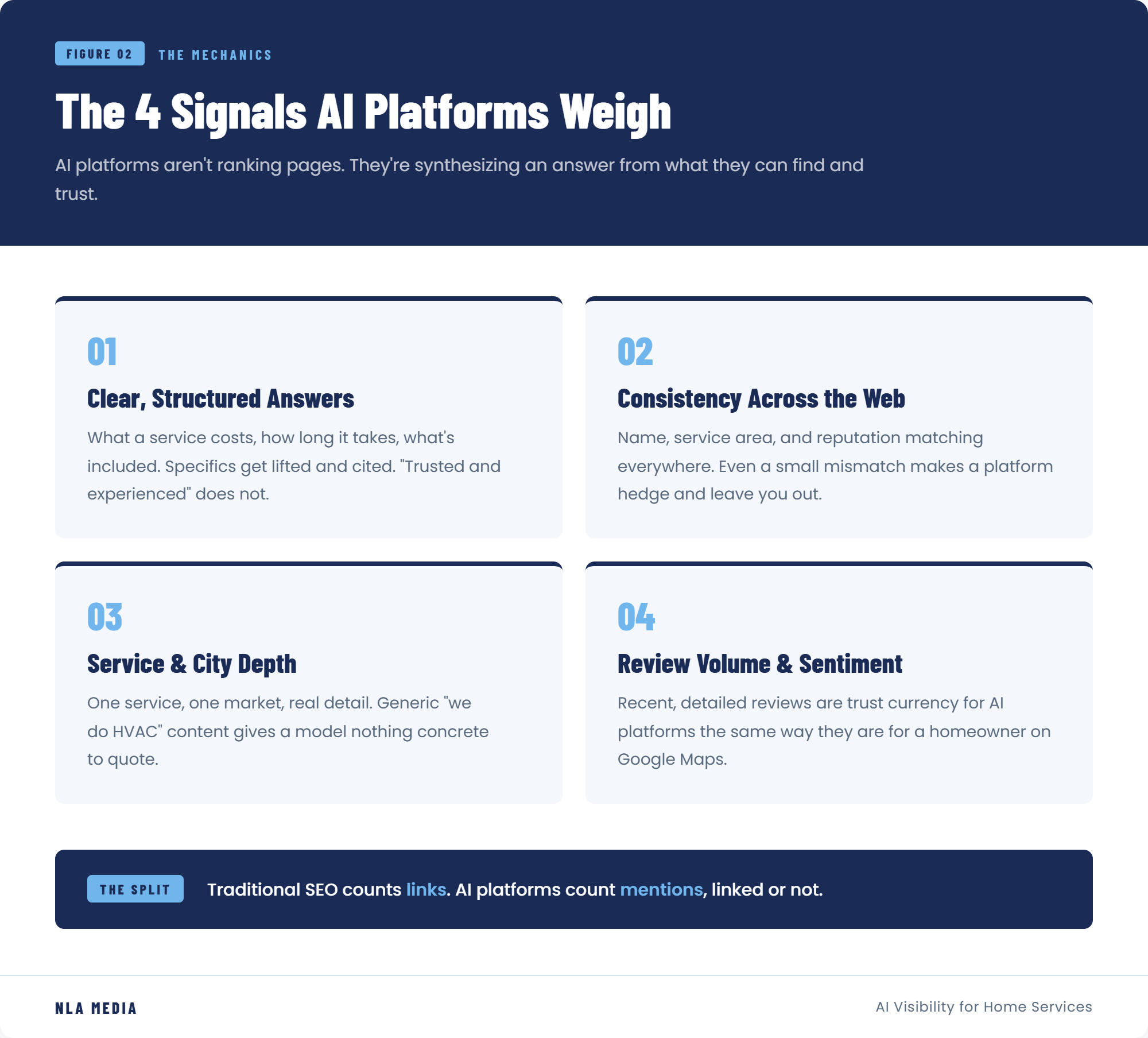
AI platforms aren't ranking pages the way a traditional search engine does. They're synthesizing an answer from whatever they can find and trust, which means they lean on a different set of signals than classic SEO rewards. Four things matter most.
Clear, structured answers. Content written in a direct question-and-answer format, with real specifics rather than vague marketing language, is easier for an AI model to lift and cite. A page that clearly states what a service costs, how long it takes, and what's included gets pulled into answers more often than a page that just says the company is "trusted" and "experienced."
Consistency across the web. AI platforms cross-reference. A business name, service area, and reputation that show up the same way across your website, your Google Business Profile, directories, and review platforms builds the kind of confidence that gets a company named. Inconsistency, even small stuff like a slightly different service area description in two places, makes a platform hedge and leave you out.
Depth on the specific service and city. Generic "we do HVAC" content doesn't give an AI model much to work with. A page built around a specific service in a specific city, with real detail about how that service works in that market, gives the model something concrete to cite and quote from.
Review volume and sentiment. This one carries over from traditional local SEO almost untouched. A steady flow of recent, detailed reviews still functions as trust currency for AI platforms the same way it does for a homeowner scrolling Google Maps.
If you want to see what service-and-city depth actually looks like in practice, take a look at how we've built out marketing for electrician companies. Every page is built around one service in one market, on purpose.
Section 04: In Practice
What This Looks Like in the Real World
This isn't theoretical for us. We've had a client close a deal and, when asked how they found us, say flat out that an AI platform recommended NLA Media specifically. Not a Google ad. Not a referral. An AI assistant surfaced us as the answer to whatever they asked, and they called because of it. That's the whole shift in one sentence: the recommendation happened before the human ever typed a search into a browser.
For a home services company, the equivalent moment looks like this. A homeowner in your service area asks an AI platform something like "who's a reliable HVAC company near me that does same-day repairs," the platform pulls together an answer from whatever content and reputation signals it can find, and it either says your name or it doesn't. There's no ad auction to win in that moment and no way to buy your way into the answer after the fact. The groundwork has to already be there.
That's a genuinely different kind of visibility than what most home services marketing has chased for the last decade, and it's why we treat AIO and GEO as a core part of the strategy rather than a bonus tactic tacked onto traditional SEO.
Curious what the buildout actually looks like for a specific trade? Marketing for HVAC companies is a good example of the service-and-city structure that gives AI platforms something worth citing.
Section 05: Overlap and Split
Where Traditional SEO and AI Visibility Overlap, and Where They Split
The good news for anyone who has already invested in local SEO is that most of the foundation carries over. The bad news is that "most" isn't "all," and treating AI visibility as identical to traditional SEO leaves real ground on the table.
| Shared Foundation | Google Business Profile accuracy, review volume and recency, site speed, and consistent NAP data across the web | Both Reward It |
| ↓ | ||
| Traditional SEO Leans On | Backlink authority, keyword targeting, page-level ranking factors, click-through rate | Rankings |
| ↓ | ||
| AI Visibility Leans On | Direct-answer content structure, cross-web consistency, entity clarity, being mentioned (not just linked) across the web | Recommendation |
The biggest practical split is in what counts as a signal at all. Traditional SEO cares almost entirely about links pointing back to your site. AI platforms care about mentions, whether or not they're linked. A local news write-up, a directory listing, a Reddit thread where a homeowner casually recommends you, a review site quote, none of those need a backlink to influence an AI platform's confidence in naming you. That opens up a much wider set of places worth showing up in than a link-building campaign alone would ever target.
Section 06: The Strategy
Building AI Visibility Without Starting Over
None of this requires ripping out an existing SEO program and replacing it. It requires layering AI-specific work on top of a foundation that, for most home services companies, is already partially in place.
Start with your existing service and city pages and ask a blunt question: could an AI model lift a clean, specific answer out of this content, or would it have to guess? Pages full of vague value statements give a model nothing to cite. Pages that state a real answer, real pricing ranges, real timeframes, and real specifics about how a service works in that particular city give it something worth quoting directly.
From there, widen the lens beyond your own website. Where does your company get mentioned that isn't a backlink? Local news, community Facebook groups, Nextdoor threads, review platforms, industry directories. Each one is a small vote of confidence an AI platform can pick up on, and most home services companies have never actively pursued them because traditional SEO never rewarded the effort.
FAQ content earns its keep here more than almost any other format. A well-structured FAQ section with a real question and a specific, direct answer is close to the exact shape an AI platform is trying to extract from the web anyway. You're doing half its work for it, and that's precisely why it gets cited.
Same principle, different trade. Marketing for plumbing companies shows the FAQ-and-specifics approach applied to a service where trust and urgency both run high.
Section 07: Getting Started
Where to Start This Quarter
AI visibility isn't a separate project that competes with your existing marketing budget. It's a lens to apply to the work you're likely already doing. Here's the practical order of operations.
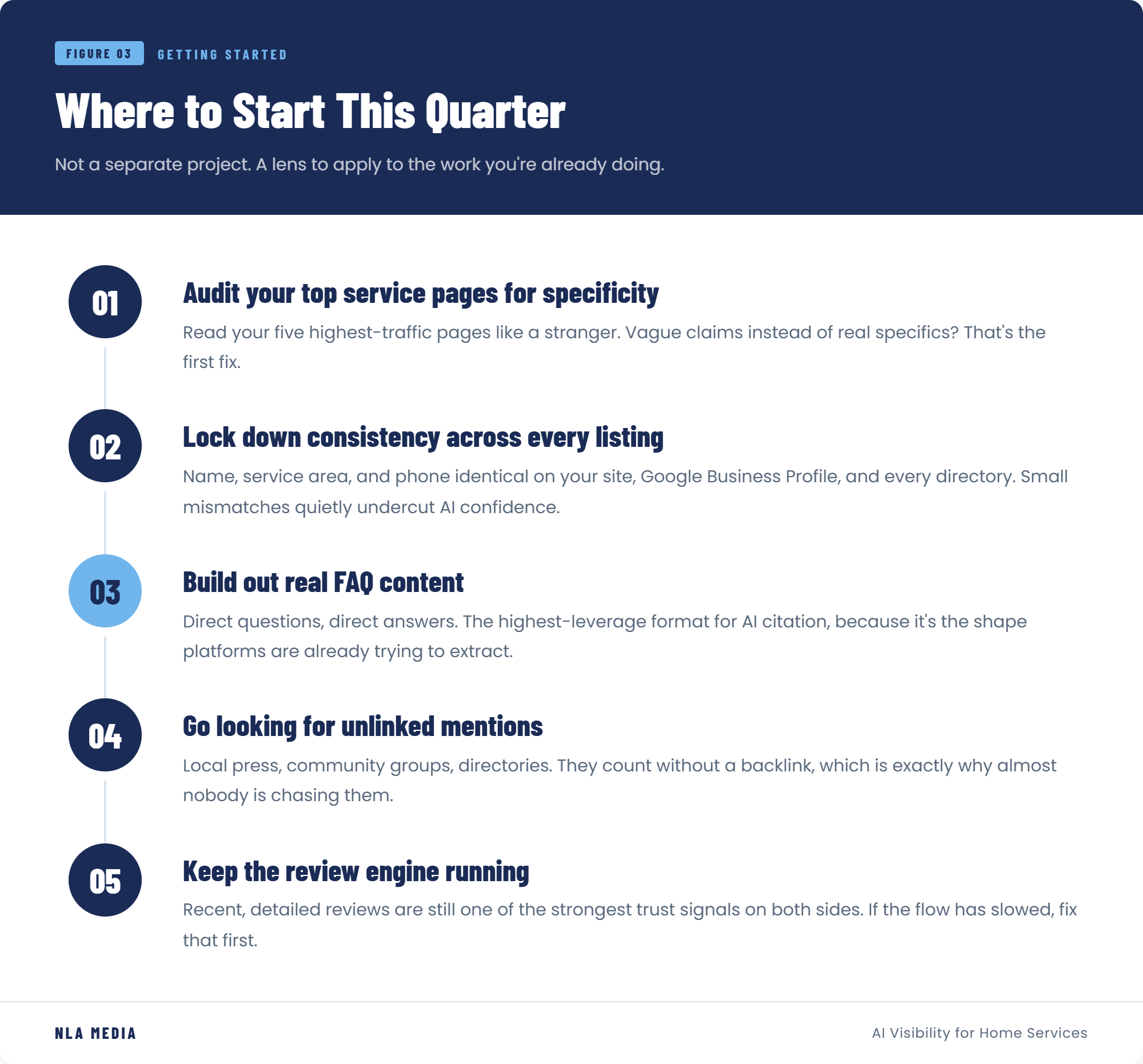
Audit your top service pages for specificity
Pull up your five highest-traffic service pages and read them like a stranger who knows nothing about your company. If the content leans on vague claims instead of real specifics, that's the first fix.
Lock down consistency across every listing
Business name, service area, and phone number should read identically across your website, Google Business Profile, and every directory you're listed on. Small mismatches quietly undercut AI confidence.
Build out real FAQ content
Direct questions with direct, specific answers, not marketing copy dressed up as a question. This is the highest-leverage content format for AI citation.
Go looking for unlinked mentions
Local press, community groups, and directories that mention you without linking still count. Actively pursuing them is new territory for most home services companies, and that's exactly why it's an opportunity.
Keep the review engine running
Recent, detailed reviews remain one of the strongest trust signals for both traditional search and AI platforms. If your review flow has slowed down, that's worth fixing before anything else on this list.
None of these steps require a total teardown of what's already working. They require treating AI platforms as a real, growing referral source and building the specific, consistent, citable presence that earns a mention when a homeowner asks who to call.
Key Takeaways
- AI platforms increasingly hand homeowners a direct recommendation instead of a list of links, which means the goal shifts from ranking well to being the answer.
- Home services searches are urgent, local, and trust-heavy, which is exactly the combination that pushes AI platforms toward naming one company instead of listing several.
- AI platforms weigh clear, specific, question-and-answer content, cross-web consistency, service-and-city depth, and review sentiment more heavily than classic ranking factors.
- Mentions matter even without a backlink. Local press, directories, and community discussion all influence AI confidence in ways traditional SEO never rewarded.
- Most of the foundation from traditional local SEO carries over, including Google Business Profile accuracy and review volume.
- The biggest gap most home services companies have is content specificity. Vague marketing language gives an AI model nothing worth citing.
- FAQ content structured as real questions with specific answers is one of the highest-leverage formats for earning an AI citation.
- This is already producing real results. AI-driven recommendations are showing up as an actual client discovery channel, not a hypothetical one.
Frequently Asked Questions
What is AIO or GEO in marketing?
AIO stands for AI Optimization and GEO stands for Generative Engine Optimization. Both refer to the practice of structuring a business's online presence so that AI platforms like ChatGPT, Perplexity, and Google AI Overviews are more likely to surface that business when someone asks a relevant question. It's a companion discipline to traditional SEO, not a replacement for it.
Is AI search really replacing Google for home services searches?
Not replacing, but increasingly sitting alongside and even inside it. Google's own AI Overviews now appear directly within standard search results for a large share of local service queries, and dedicated AI platforms are capturing a growing share of "who should I call" style searches. Traditional search still matters, but it's no longer the only door homeowners walk through.
Do I need to abandon my local SEO strategy to focus on AI visibility?
No. Most of what makes a home services business strong in local SEO, an accurate Google Business Profile, consistent business information, and a steady flow of reviews, also supports AI visibility. The work is additive: layer in more specific, citable content and pursue unlinked mentions across the web rather than replacing what's already working.
How does an AI platform decide which home services company to recommend?
AI platforms synthesize an answer from the content and reputation signals they can find and trust. That includes how specific and well-structured a company's content is, how consistently the business appears across the web, how deep its service and city-specific content goes, and how strong and recent its reviews are. Companies that give clear, quotable answers get cited more often than companies relying on vague marketing language.
What's the fastest way to start improving AI visibility?
Start with FAQ content built around real questions and specific answers, since that format is close to exactly what AI platforms are trying to extract from the web. Pair it with a consistency check across your website, Google Business Profile, and directory listings, since mismatched information quietly undermines AI confidence even when the underlying business information is accurate.
Can a home services company actually get recommended by name in an AI answer?
Yes, and it's already happening. We've had clients tell us directly that an AI platform recommended NLA Media by name before they ever reached out, and the same dynamic applies to home services businesses that build the right kind of specific, consistent, citable presence across the web.
Are You the Answer, or the Ten Blue Links They Skipped?
AI platforms are already recommending home services companies by name, and every day yours isn't part of that conversation is a lead someone else is picking up. NLA Media builds marketing programs that show up in both the search results and the AI answer. Call us at (719) 635-9988 or click below to book your strategy call.
Book My Strategy Call