

Every year someone declares SEO dead. This year it is AI Overviews and chatbots getting the blame. The panic is understandable and mostly misplaced. SEO did not die. It split into two related but distinct jobs: ranking in traditional Google search results, and being the source an AI system pulls from when it answers a question directly. Businesses that only do the first job are watching their organic traffic get intercepted before it ever reaches their website. Businesses that understand both jobs are showing up in more places, more often, in front of more of the customers who are ready to buy. This guide breaks down what actually changed in search, what did not, and how to build a website that performs in both worlds at once.
Section 01The Panic
SEO Is Not Dead. It Split Into Two Jobs.
The "SEO is dead" narrative shows up every time search changes in a visible way. It showed up when mobile search overtook desktop. It showed up when featured snippets started answering questions directly on the results page. It is showing up now because AI Overviews and AI chat platforms like ChatGPT and Perplexity are answering questions in full sentences instead of handing over a list of blue links. Each time, the headline is the same and the reality is the same: the way people search changed, and the businesses that adapted kept growing while the ones that did not lost ground.
Two Disciplines, Not One
What is actually happening in 2026 is that search has split into two related disciplines. The first is traditional SEO: ranking your website in the organic results Google has always shown, the ones a person clicks through to read on your site. The second is what most people are now calling AIO or GEO, short for AI Optimization or Generative Engine Optimization: the practice of being the source that an AI system cites, summarizes, or pulls from when it answers a question directly instead of sending the person to a list of websites.
These two disciplines overlap heavily but are not identical. A page can rank well in traditional search and never get cited in an AI Overview. A page can get cited constantly in AI answers while never cracking the first page of traditional results. The businesses winning in 2026 are building for both at once, because a shrinking share of searches end in a click to any website at all, and the businesses that only optimize for clicks are optimizing for a smaller and smaller piece of the pie.
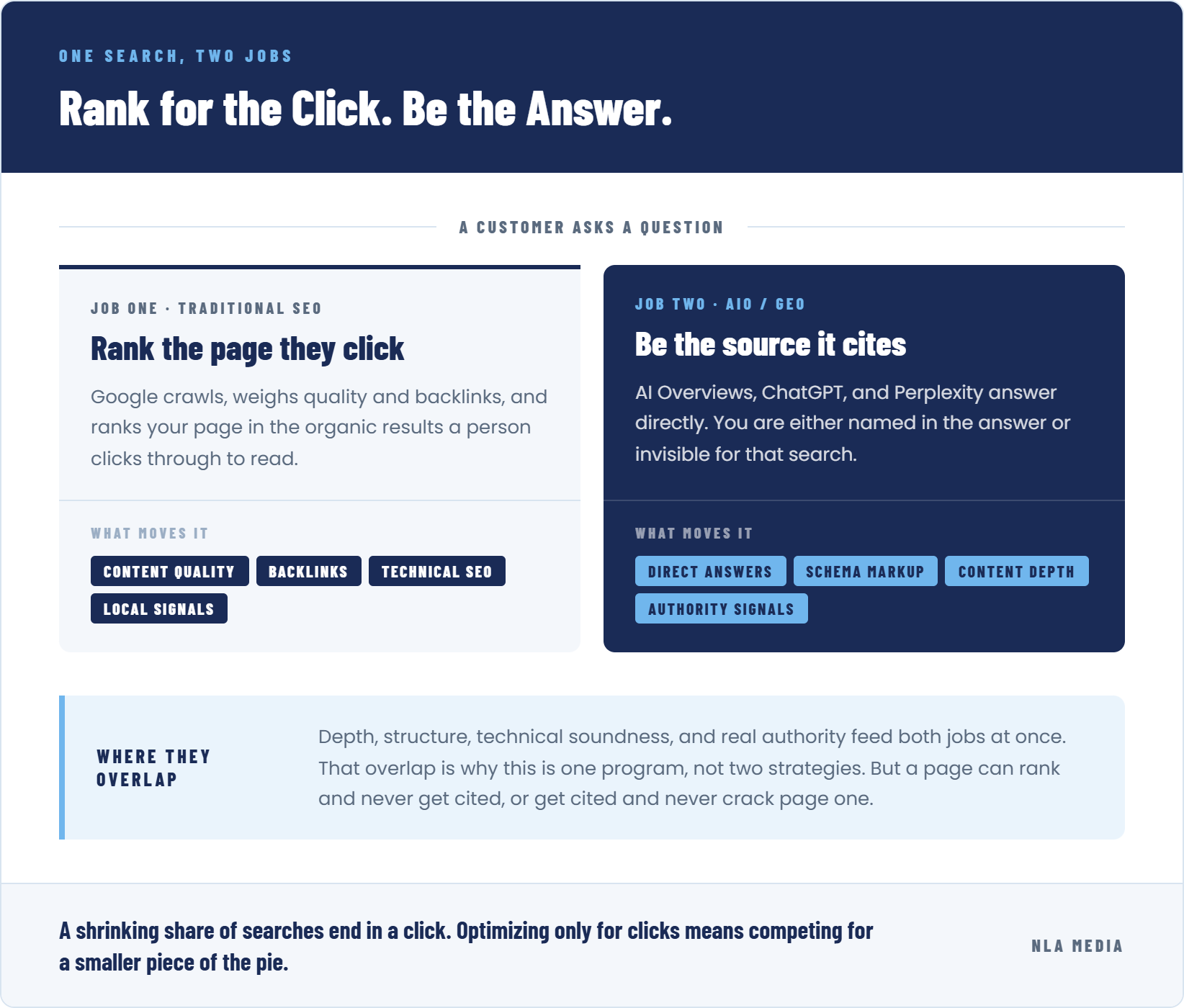
SEO did not die. It split into ranking for the click and being the source for the answer, and most businesses are only building for one of the two.
Section 02Traditional Search
The Google Search Everyone Still Knows
Before getting into what changed, it is worth being direct about what did not: the fundamentals of traditional SEO are still the fundamentals. Google still crawls your website, still evaluates the quality and depth of your content, still weighs backlinks as a signal of authority, and still factors in technical performance like page speed, mobile usability, and clean site structure. None of that went away, and none of it is going away. Businesses that skip the fundamentals because they read that "AI changed everything" are making a costly mistake.
Content quality remains the foundation everything else is built on. Thin, templated content that exists only to target a keyword continues to underperform genuinely useful, specific content that actually answers what the searcher is asking. This was true in 2015 and it is true now, and if anything the bar has risen, because Google has gotten significantly better at distinguishing genuinely helpful content from content that was produced to game a ranking algorithm.
Backlinks still matter as a trust and authority signal. A website that other credible sites link to is still treated as more trustworthy than one that exists in isolation, and building a natural backlink profile through genuinely link-worthy content, partnerships, and press remains one of the highest-value long-term SEO investments available. Technical SEO, including page speed, mobile responsiveness, clean URL structure, and proper schema markup, still forms the infrastructure that everything else depends on, which is why website design and SEO strategy need to be built together rather than treated as separate projects. A brilliant piece of content on a slow, poorly structured website will underperform the same content on a fast, well-built site every time.
Local Signals Still Decide Who Shows Up in the Map Pack
Local SEO factors, including a complete and active Google Business Profile, consistent business information across the web, and a steady stream of legitimate reviews, remain the deciding factor in whether a local service business shows up in the map pack results that dominate local search. This is the core of what local SEO actually covers, and none of it is new. All of it is still true. The mistake businesses make is assuming that because something new (AI Overviews) entered the picture, the old rules stopped mattering. They did not. They became necessary but no longer sufficient.
Section 03AI Overviews
What AI Overviews Actually Changed
AI Overviews are the AI-generated summaries that now appear at the top of many Google search results, synthesizing information from multiple sources into a direct answer before any traditional organic result appears on the page. For a large and growing share of searches, particularly informational ones like "how does X work" or "what is the best way to Y," the searcher gets their answer directly in the AI Overview and never scrolls down to click a traditional result at all.
Zero-Click Search Is Real, and It Is Growing
This is the change that is actually reshaping search behavior, and it is a real one. Zero-click searches, meaning searches that end without the person clicking through to any website, have been climbing for years and AI Overviews have accelerated that trend significantly. For businesses that built their entire digital strategy around ranking in position one through five of traditional organic results, this is a genuine problem, because a meaningful share of the people who would have clicked through are now getting their answer without ever seeing the website at all.
The businesses that show up inside the AI Overview itself, cited as the source of the synthesized answer, are capturing visibility and often clicks even in a zero-click search environment, because AI Overviews frequently link to and name the sources they pulled from. The businesses that do not show up inside the AI Overview are effectively invisible for that search, regardless of how well they would have ranked in the traditional results below it.
What Gets a Business Cited Inside an Overview
What determines whether a business gets cited inside an AI Overview is not identical to what determines traditional ranking, though there is significant overlap. Content that is structured clearly, answers a specific question directly and early, and comes from a source Google's systems have identified as credible and authoritative tends to get pulled into these summaries. Content that is well-optimized for traditional ranking but structured as a long narrative without a clear, quotable answer near the top tends to rank well traditionally while getting passed over for AI Overview citation.
Section 04AIO and GEO
Enter AIO and GEO: Being the Answer, Not Just a Result
AI Overviews are just one piece of a bigger shift. Millions of people are now asking ChatGPT, Perplexity, and similar AI platforms questions directly instead of searching Google at all: "who is the best plumber in my area," "what should I look for in an HVAC contractor," "how do I know if I need a new electrical panel." These platforms answer with a synthesized response, sometimes citing sources and sometimes not, and the businesses those platforms recommend are getting warm, high-intent leads that never touched a traditional search engine.
AIO (AI Optimization) and GEO (Generative Engine Optimization) both describe the practice of building content and digital presence specifically to be the source an AI system cites, recommends, or pulls from when it answers a question. This is a genuinely new discipline, distinct from traditional SEO, though it shares more DNA with SEO than most of the breathless commentary about it suggests.
What the Businesses That Get Recommended Have in Common
The businesses getting recommended by ChatGPT and Perplexity tend to share several traits: clear, structured content that directly answers specific questions; consistent, accurate information about the business across the web (name, services, location, credentials); genuine authority signals like reviews, press mentions, and credible backlinks; and content depth that goes beyond a single service page to actually demonstrate expertise on the topics a customer would ask about. None of that is a foreign concept to anyone who has done SEO well for the past decade. It is the same fundamentals, applied with an eye toward a new kind of reader: a language model synthesizing an answer, not a person scanning a list of links.
We wrote a full breakdown of how to build for this shift in our AIO/GEO guide, and a head-to-head comparison of the platforms themselves in ChatGPT vs. Perplexity vs. Google AI Overviews.
Section 05Myths vs. Reality
What Actually Changed vs. What Did Not
A lot of confident, contradictory claims circulate about SEO every time the search landscape shifts. Here is a clear-eyed breakdown of what is actually true heading into the back half of 2026.
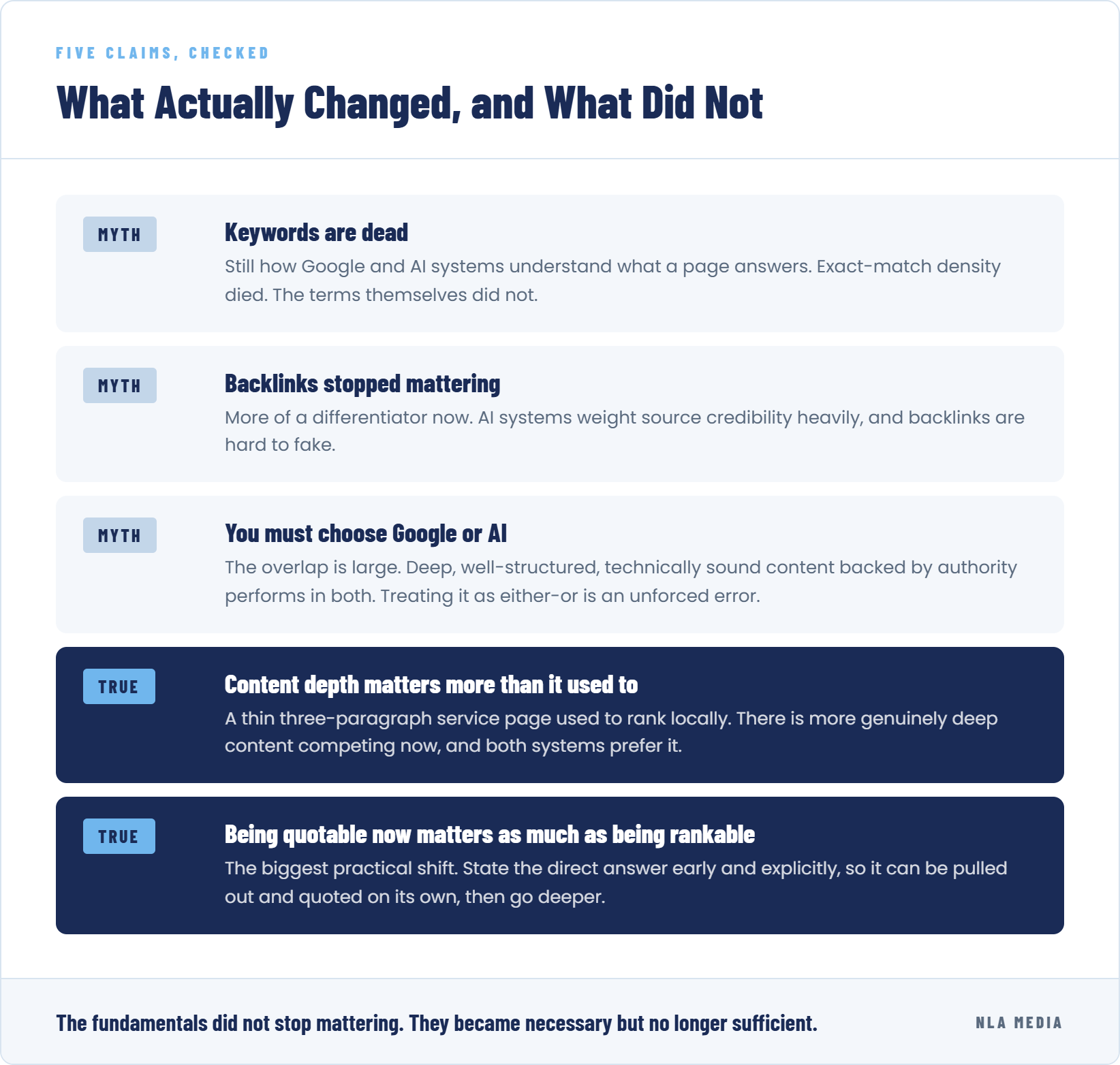
Myth: Keywords Are Dead
False. Keywords still matter, both for traditional ranking and for AI citation, because they are still how Google and AI systems understand what a piece of content is about and what question it answers. What changed is the obsession with exact-match keyword density. Writing naturally around the topics and questions your customers actually search for has replaced keyword-stuffing as the effective strategy, but the underlying need to address the terms people search for has not gone anywhere.
Myth: Backlinks Do Not Matter Anymore
False. Backlinks remain one of the strongest trust and authority signals in both traditional SEO and AI citation. If anything, backlink authority has become more important as a differentiator, because it is one of the harder signals to fake or shortcut, and AI systems appear to weight source credibility heavily when deciding what to cite.
Truth: Content Depth Matters More Than It Used To
Genuinely true. A single thin service page describing what you do in three paragraphs used to be enough to rank for a local search term. It is far less competitive now, both for traditional ranking and for AI citation, because there is more genuinely deep, useful content competing for the same queries, and both Google and AI systems have gotten better at recognizing and preferring it.
Truth: Being Quotable Now Matters as Much as Being Rankable
Genuinely true, and this is the biggest practical shift. Content that states a clear, direct answer to a specific question early and explicitly, in a way that could be pulled out and quoted on its own, performs better in AI citation than content that builds toward its point gradually across a long narrative. This does not mean abandoning good writing. It means structuring content so the direct answer is present and clear, even if the surrounding content goes deeper.
Myth: You Have to Choose Between Optimizing for Google or Optimizing for AI
False. The overlap between what works for traditional ranking and what works for AI citation is large. Content that is genuinely deep, well-structured, technically sound, and backed by real authority signals tends to perform well in both. The businesses treating this as an either-or choice are making an unforced error. The fundamentals support both goals simultaneously.
Section 06Building for Both
How to Build for Both Google and AI at Once
The good news in all of this is that businesses do not need two separate strategies. A single, well-executed content and technical SEO program, the kind a full-service marketing agency builds as one coordinated effort rather than a patchwork of vendors, covers most of what both traditional search and AI platforms are looking for. Here is what that program actually includes.
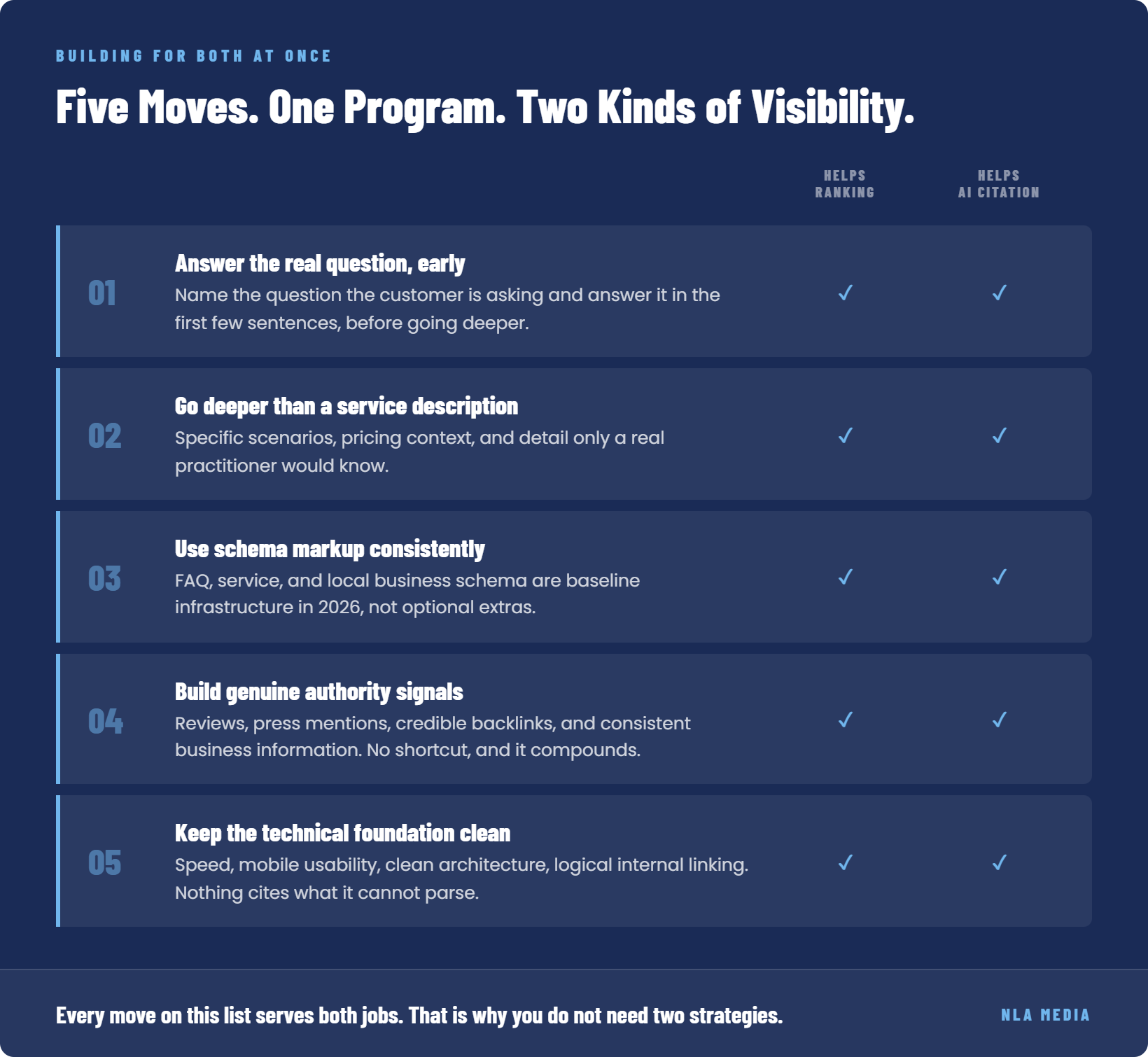
Structure content around real questions, answered directly and early. Every page should identify the specific question a customer is asking and answer it clearly within the first few sentences of the relevant section, before going deeper. This serves the human reader who wants the answer quickly and gives AI systems a clean, quotable answer to pull from.
Go deeper than a single service description. A page that only describes what you offer in generic terms is easy for competitors to match and easy for both Google and AI systems to treat as interchangeable with a hundred similar pages. Content that demonstrates genuine expertise, including specific scenarios, pricing context, and the kind of detail only a real practitioner would know, differentiates in both worlds.
Use schema markup consistently. Structured data helps both Google and AI systems understand exactly what your content is, what questions it answers, and how it relates to your business. FAQ schema, service schema, and local business schema are not optional extras in 2026. They are baseline infrastructure for any business serious about visibility in either search environment.
Build genuine authority signals. Reviews, press mentions, credible backlinks, and consistent, accurate business information across the web all feed both traditional ranking and AI citation likelihood. There is no shortcut here. This is earned over time through genuinely good service and genuine outreach, and it compounds for both goals simultaneously. Our case studies walk through what that looks like in practice across several industries.
Keep the technical foundation clean. Fast load times, mobile usability, clean site architecture, and a logical internal linking structure remain the infrastructure everything else is built on. Neither Google nor any AI system is going to cite or rank content it cannot crawl and parse efficiently, which is why strong website design is not a separate line item from SEO, it is part of it.
Key Takeaways
- SEO did not die. It split into ranking in traditional search results and being cited as a source in AI-generated answers, and both now matter.
- The fundamentals of traditional SEO, including content quality, backlinks, technical performance, and local signals, are all still true and still necessary.
- AI Overviews and zero-click search are real and growing, which means businesses that only optimize for clicks are competing for a shrinking share of total search visibility.
- AIO and GEO describe the practice of being the source an AI platform cites or recommends, and share significant overlap with traditional SEO fundamentals.
- Keywords and backlinks are not dead, despite frequent claims otherwise. Content depth and quotability now matter more than they used to.
- A single, well-built content and technical SEO program can serve both traditional ranking and AI citation goals simultaneously. Businesses do not need two separate strategies.
Frequently Asked Questions
Is SEO still worth investing in with AI Overviews and chatbots taking over search?
Yes. Traditional SEO fundamentals, including content quality, backlinks, and technical performance, remain necessary for both ranking in Google's organic results and being cited inside AI Overviews and AI chat platforms. The businesses opting out of SEO because they believe AI replaced it are ceding ground in both search environments at once.
What is the difference between SEO and AIO or GEO?
Traditional SEO focuses on ranking a webpage in the organic results a person clicks through to visit. AIO (AI Optimization) and GEO (Generative Engine Optimization) focus on being the source an AI system cites, summarizes, or recommends when answering a question directly, whether inside a Google AI Overview or a platform like ChatGPT or Perplexity. The two disciplines overlap significantly but are not identical.
Do backlinks still matter for SEO in 2026?
Yes, and arguably more than ever. Backlinks remain one of the strongest available signals of trust and authority for both traditional ranking and AI citation. Businesses that build genuine backlink authority through link-worthy content and outreach continue to outperform those that do not, in both search environments.
How do I get my business cited in AI Overviews or recommended by ChatGPT?
Structure content to answer specific questions clearly and directly, build genuine content depth beyond generic service descriptions, use schema markup consistently, and build authority signals including reviews and credible backlinks. There is no guaranteed shortcut, but businesses that build genuinely deep, well-structured, and well-cited content see meaningfully better results in AI citation than those relying on thin, generic pages.
Should I stop targeting keywords since AI search is more conversational?
No. Keywords still matter for both traditional ranking and AI citation, because they remain how search systems understand what your content is about. What has changed is the effective approach: writing naturally around the actual questions and terms your customers use has replaced keyword-stuffing, but the underlying need to address those terms has not disappeared.
Can a small local business really compete for AI citation against bigger competitors?
Yes, often more easily than in traditional organic rankings. AI systems tend to reward genuine specificity and local relevance, and a local business with deep, accurate, well-structured content about its actual service area and services can out-cite a larger competitor with generic, templated content. Authenticity and depth matter more than sheer domain authority in AI citation than they historically have in traditional ranking alone.
Ready to Build for Both Google and AI Search?
NLA Media builds SEO and SEO agency programs that cover the traditional ranking fundamentals and the AIO/GEO fundamentals at once, so your business shows up whether a customer clicks through Google or asks an AI platform directly. Call us at (719) 635-9988 or click below to book your strategy call.
Book My Strategy Call