


If your business operates in one city, this post is not for you, and honestly, congratulations, your website life is easier than you know. But if you are running a company that services ten cities, or forty-four of them, or somewhere in between, you have probably already discovered the uncomfortable truth: a normal website was never built to do what you are asking it to do. Here is the story of how we solved that problem for one client, and why the way you solve it matters a lot more than most business owners realize.
Section 01: The Problem
The Multi-Location Problem Nobody Warns You About
One Location vs. Dozens: A Completely Different Job
Most websites are built for one place. One homepage, one service area section, maybe a map with a few pins on it, and that covers it. It works fine right up until it does not, which is usually right around the third or fourth city a company expands into.
That is the moment a lot of business owners try the fast fix: take the homepage, duplicate it, swap in a new city name, and call it a location page. It feels efficient. It is not. Search engines have gotten extremely good at recognizing pages that are structurally identical with a word or two changed, and they rank those pages accordingly, which is to say, they mostly do not.
A website built for one location does not get worse as you expand. It gets a completely different job, and most sites were never hired for that job.
Where Normal Websites Start to Buckle
Multiply that problem across dozens of cities and multiple services, and a normal website architecture starts groaning under its own weight. You end up with either a handful of thin pages that barely mention your actual service areas, or a pile of near-duplicate pages that Google quietly deprioritizes because none of them look like they were written for an actual human being sitting in that actual city.
The businesses that feel this most acutely are the ones growing fastest: home services companies, franchises, multi-market contractors, anyone whose growth strategy is "we go where the work is." Growth is the good problem. But it turns your website from a brochure into an operation, and operations need a system, not a template with find-and-replace.
Section 02: The Fake Fix
Why "Find and Replace the City Name" Fools No One
It Looks Efficient. It Is Not.
We want to be direct about this one because it is the single most common shortcut we see, and it is tempting for a good reason: it is fast, it is cheap, and on the surface it looks like it should work. Same layout, same headline structure, just a different city plugged in. Do that fifty times and you have "covered" fifty markets.
Except you have not. Search engines read the actual substance of a page, not just its city name, and a template with the city swapped in has no substance that changes from one page to the next. The neighborhoods are not mentioned. The local considerations are not addressed. The page reads exactly the same in Tulsa as it does in Fort Smith, and Google notices that pattern immediately once you have more than a handful of pages doing it.
Your Customers Notice Too
Humans notice too, even if they could not name what feels off. A page that never mentions anything specific to their actual town reads as generic, and generic reads as "this company probably has not actually worked here before." For a business that lives and dies on local trust, that is the opposite of the impression you want to make.
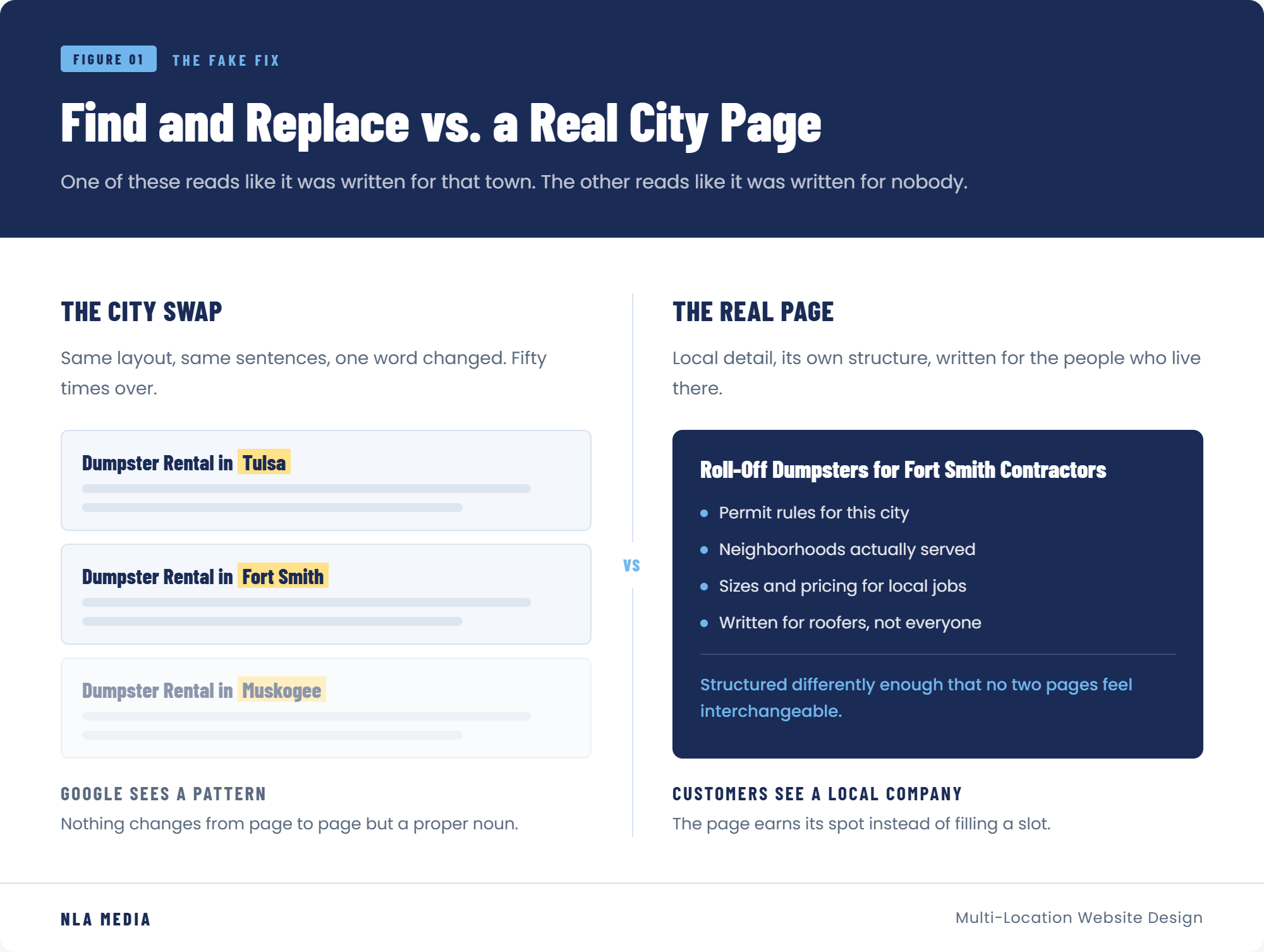
Same layout, two completely different outcomes.
The fix is not more pages. It is genuinely different pages, which sounds obvious until you try to do it at scale without a system behind it.
Section 03: What It Actually Takes
What Real Location Coverage Actually Takes
Every Page Has to Earn Its Spot
Genuine multi-location content means every page earns its spot. A city page should read like someone who knows that city wrote it, because in a very real sense, someone did the work to make sure it does. That means real local detail, content that is structured differently enough from page to page that no two pages feel interchangeable, and a site architecture that can hold dozens or hundreds of these pages without turning into an unmanageable mess behind the scenes.
That last part is the piece most people underestimate. It is not hard to write one great city page. It is hard to write ninety of them, keep them all genuinely distinct from one another, keep the whole thing organized so pages link to the right services and the right sister pages, and keep it maintainable so that adding city ninety-one next year does not mean rebuilding the whole system from scratch.
This Is an Operation, Not a Project
That is a content operation, not a content project. It needs a plan for how pages relate to each other, a plan for how new markets get added without breaking what already exists, and a genuinely stubborn commitment to originality even when it would be so much easier to just copy the page next door. We will not walk through our own internal playbook for how we pull that off. But we can tell you what it looks like when someone does it right, because we just finished doing it.
Before we ever offered this to a client, we ran the entire approach on our own website first. Same principles, same discipline, no shortcuts, our own site as the guinea pig. Once we saw what it did for our own rankings, we knew it was worth building the system out properly and offering it to the clients who needed it most.
Section 04: The Case Study
The MSG Waste Services Story
The Challenge: 44 Cities, One Website
MSG Waste Services is a family-owned dumpster rental and commercial waste company covering 44 cities across Western Arkansas and Eastern Oklahoma. That is not a footnote, that is the whole challenge in one sentence. A normal website does not know what to do with 44 cities. Neither, frankly, do most agencies. You can see the finished site for yourself at msgwaste.com.
The starting point was simple to say and hard to do: every city needed to feel real, every service needed its own genuine explanation in that city's context, and the whole thing needed to hold up to the same scrutiny a search engine and a skeptical local customer would both apply. No shortcuts, no city-name swaps, no pages that could be mistaken for a template.
How the Build Actually Came Together
We built this in layers rather than all at once. Think of it less like writing a book and more like building a small city of content: the main page for each location goes up first, then the pages underneath it for each core service, then the pages underneath those for specific details, and finally an entire layer aimed at the specific industries MSG serves in each market, things like roofers, restaurants, and property managers, each with content written for how that particular type of customer actually thinks about waste service.
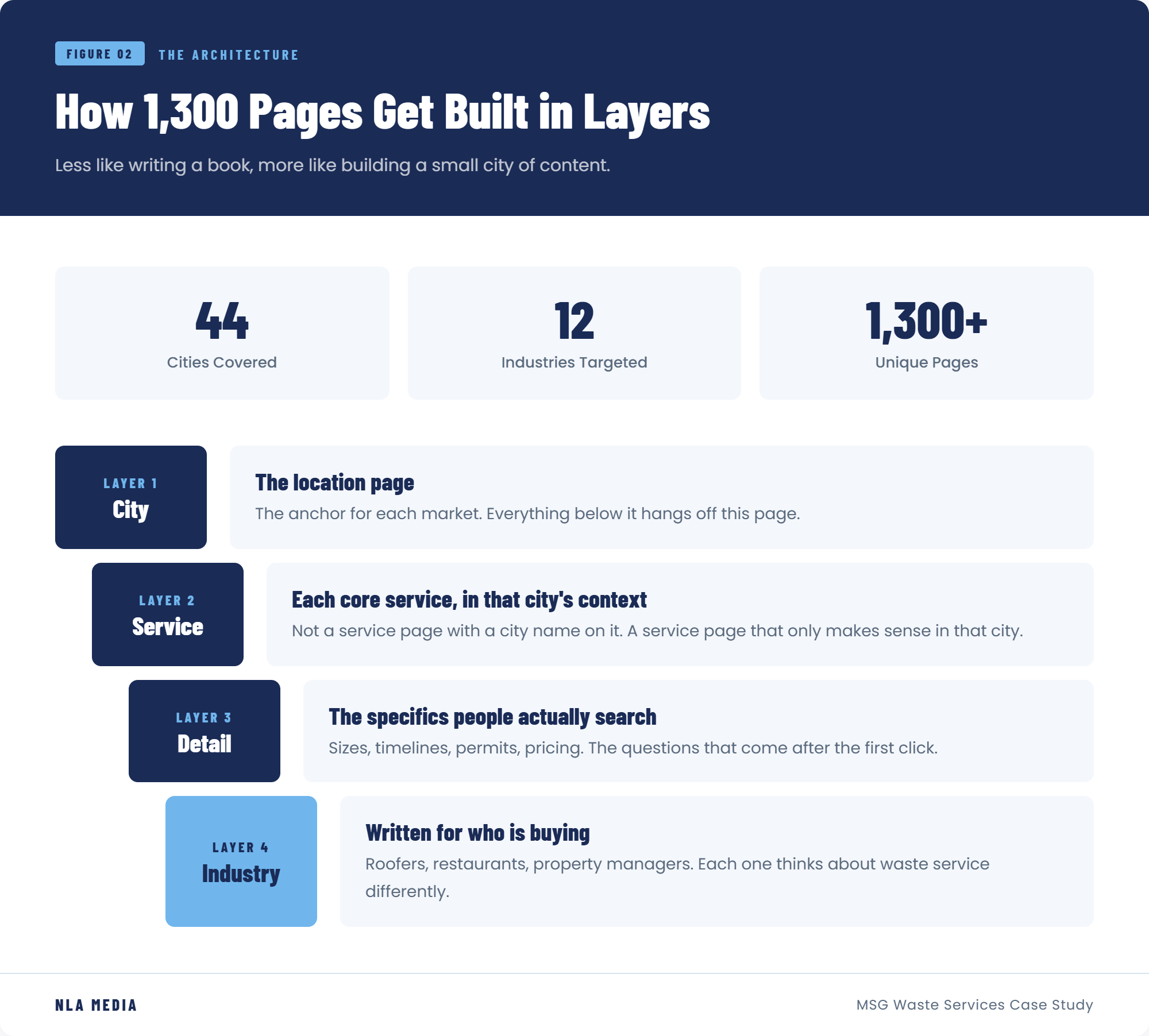
More than 1,300 pages, built layer by layer rather than all at once.
We did not build one city and copy it forty-three times. We built a system that could produce forty-four genuinely different cities without forty-four times the chaos.
Proving It Before Scaling It
Before scaling to all 44 markets, we proved the system twice. One city went first as a full proof of concept, checked line by line before anything else touched it. A second city followed to stress-test the entire pipeline end to end, on the theory that the second attempt always reveals problems the first one hides. Only once both of those held up did the remaining 42 cities move forward, in structured batches rather than all at once, so nothing important got missed at volume.
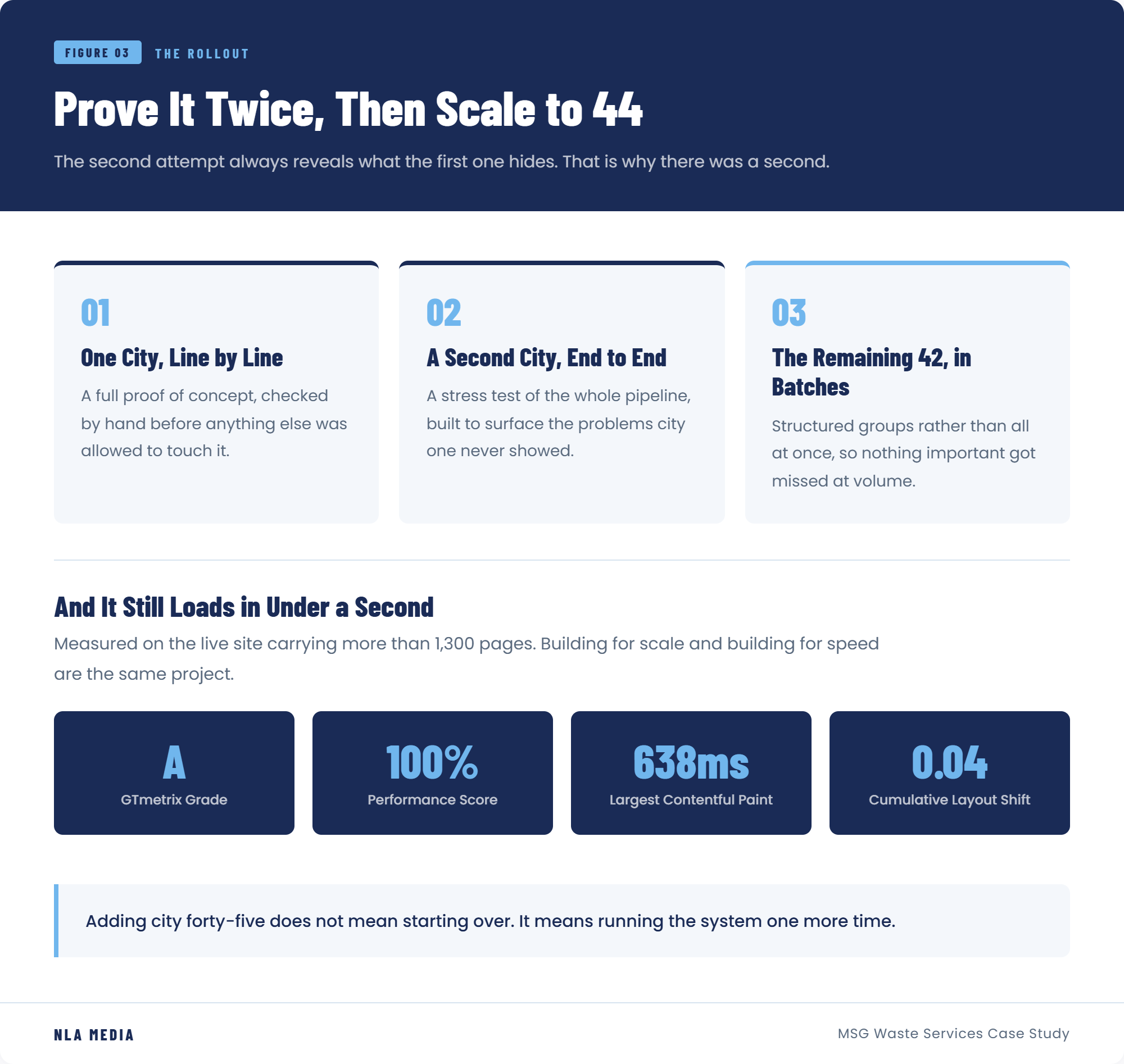
Prove it once, stress-test it once, then scale with confidence.
Honestly, the least glamorous part of the whole project was also the most important: figuring out exactly how the pieces of the website relate to each other so links and pages build correctly, catching mistakes before they quietly overwrote something that mattered, and making the judgment call, every single time, about what "genuinely unique" actually requires rather than what would be easiest to get away with. That is not a fun sentence to put in a blog post. It is, however, the entire reason the finished site works.
Worth noting: this build just went live, so we do not have MSG's ranking results to show off yet. That is normal. Google needs time to crawl and index over 1,300 new pages before those rankings show up. This is not our first time running this exact playbook for a multi-location client, and we know what the results look like once the dust settles. We will update this post with real numbers once Google has had a chance to catch up.
Section 05: The Payoff
The Payoff: What This Kind of Site Actually Buys You
Three Things That Compound
Here is the part that matters to a business owner reading this instead of the agency doing the building: what does all of that plumbing actually get you? A few things, and they compound.
First, you show up where your customers are actually searching, in their own city, for their own service, instead of hoping a single generic service area page catches all of it. Second, you build credibility the moment someone lands on the page, because it reads like a company that actually knows their town rather than a company that found their town on a map. Third, and this is the one that pays off for years, the site keeps working as you grow. Adding city forty-five does not mean starting over. It means running the system one more time.
That last point is worth sitting with. A lot of multi-location websites age badly because every new market means another round of manual, expensive, one-off work. A site built the right way from the start scales the way your business actually grows: steadily, market by market, without the whole thing needing to be rebuilt every time you add a new town to your route.
Speed Is Part of the Deal, Not an Afterthought
None of that matters if the site itself is slow, and a site carrying over 1,300 pages has every excuse to be. MSG's is not one of them. We ran a fresh performance check on the live site at msgwaste.com and it came back with a straight A grade, 100% on performance, and a load time fast enough that most visitors will not even register a wait.

The actual GTmetrix report for msgwaste.com.
A page loading in under a second matters for the same reason genuine city content matters: it is one more signal, to search engines and to actual visitors, that this is a company that does things properly. A slow site quietly undoes all the work that goes into ranking in the first place, because it does not matter how well a page ranks if half the people who click it bounce before it finishes loading. Building for scale and building for speed are not two separate projects. They are the same project, done right.
If your company operates in more than a handful of markets and your website still treats every location like an afterthought, that gap is costing you rankings and customers in every single one of those cities, every day.
Section 06: AI Search
What This Means for AI Search and Overviews
It Is Not Just Google Anymore
A few years ago, "ranking well" meant one thing: showing up on the first page of Google. That is still true, but it is no longer the whole picture. Customers are now asking ChatGPT, Perplexity, Google's AI Overviews, and Gemini the exact same questions they used to type into a search bar, and those platforms answer with a short list of companies pulled together on the spot. If your business is not one of the companies mentioned, you never even get the chance to make your case.
Here is the part that should catch your attention: the same shortcut that hurts you in traditional search hurts you even worse here. AI platforms are, at their core, reading comprehension engines. They pull from pages that clearly and specifically answer a question, and a templated location page with the city name swapped in simply does not have a specific answer to give. It has a generic answer wearing a city's name like a costume. AI tools skip right past that in favor of a page that actually says something real about that city, that service, and that customer.
Real Local Content Is the Whole Strategy
This is exactly why building genuinely distinct content for every city, service, and industry combination matters more now than it did a few years ago, not less. A page written with real local detail, real service specifics, and real answers to the questions a customer in that market would actually ask is a page an AI platform can confidently pull from and recommend by name. A thin, duplicated page gives an AI model nothing worth citing.
The businesses that show up in AI answers are not the ones with the most pages. They are the ones whose pages actually say something worth repeating.
The FAQ sections built into pages like these do double duty here too. They are written to answer the specific questions real customers ask, which happens to be exactly the format AI platforms favor when pulling together an answer. A well-built hub page and a well-built FAQ section are not just good for a human reader scanning the page. They are the raw material AI search tools use to decide who gets mentioned and who gets left out.
The businesses investing in real, distinct, well-structured content today are the ones positioned to get named by AI tools tomorrow, while their competitors running templated pages stay invisible in both search results and AI answers alike.
Key Takeaways
- A website built for one location has a fundamentally different job than a website built for dozens of them. Growth changes what your site needs to do, not just how big it needs to be.
- Swapping a city name into a duplicate template does not fool search engines and does not build trust with local customers. Both can tell when a page was not actually written for them.
- Real multi-location coverage requires genuinely distinct content for every city, every service, and often every type of customer, held together by a site architecture that can handle the scale without collapsing into chaos.
- The MSG Waste Services project covered 44 cities and 12 industries across more than 1,300 unique pages, proven first on one city, stress-tested on a second, then scaled in structured batches.
- The unglamorous work, the structure behind the scenes and the discipline to keep every page genuinely unique, is what actually makes a multi-location site perform. It rarely gets talked about, and it is almost always the difference between a site that ranks and one that does not.
- Done right, a multi-location website scales with your business. Adding a new market becomes a repeatable process instead of a fresh, expensive rebuild every time.
- Scale means nothing if the site is slow. MSG's live site, carrying more than 1,300 pages, still pulls an A grade and a 100% performance score, with a load time under a second.
- AI search tools like ChatGPT, Perplexity, and Google's AI Overviews favor pages with real, specific answers over templated pages, which makes genuine local content even more valuable now than it was before AI search existed.
Frequently Asked Questions
What actually makes a city page "unique" instead of just a copy with a new name?
It comes down to substance, not surface. A genuinely unique city page reflects real local detail and is structured differently enough from page to page that it does not read as interchangeable with the page next door. Changing the city name in the headline is not the same thing as changing the content, and search engines and local customers can both tell the difference.
Does a company really need over a thousand pages to cover 44 cities?
For MSG, yes, because coverage was not just city by city, it was city by service by industry. Forty-four cities times multiple core services times a dozen target industries adds up quickly. Not every multi-location business needs that level of depth on day one, but the more markets and services a company covers, the more the page count naturally grows if each combination is going to be treated seriously.
Does this only work for waste and dumpster rental companies?
Not at all. The same problem shows up for any company that operates across multiple locations: home services contractors, medical practices, franchises, specialty retailers, anyone whose customers search locally. The specific content changes by industry, but the underlying challenge, real distinct content at scale without a duplicate content mess, is the same.
How long does a project like this take from start to finish?
It depends heavily on the number of markets and services involved, but the sequence matters more than the raw timeline. Proving the approach on one location first, stress-testing it on a second, and only then scaling to the full list of markets takes longer up front than just building everything at once. It also means the finished product actually works instead of needing to be fixed after the fact.
Isn't a huge number of location pages just duplicate content with extra steps?
Only if it is done carelessly. Duplicate content problems come from pages that are too similar to each other, not from having a lot of pages. The entire point of building real distinct content for every city and service combination is to avoid exactly that trap. Done properly, more location pages means more genuine coverage, not more duplication.
What is the actual return on investing in a multi-location build like this instead of a cheaper template approach?
A template approach is cheaper today and more expensive every year after, because it does not rank well and it does not scale cleanly as the business grows. A properly built multi-location site shows up in local search results across every market it covers, builds trust with customers the moment they land on a page built for their actual city, and turns adding a new market into a repeatable process instead of a one-off project. That compounding advantage is the entire return.
Does this kind of build help with AI search tools like ChatGPT and Google's AI Overviews?
Yes, and arguably more than it helps with traditional search. AI platforms pull answers from pages that give specific, substantive information, which is exactly what a genuinely unique location page provides and a templated one does not. Businesses building real, distinct content today are positioning themselves to get named in AI-generated answers tomorrow, while competitors running templated pages are far less likely to get mentioned at all.
Operating in More Markets Than Your Website Admits?
If your company covers multiple cities and your website still treats them all the same, you are leaving rankings and customers on the table in every market you serve. Let's talk about what a real multi-location build looks like for your business.
Book My Strategy Call